Generating fractals with Halley's method
A dump of images and code.
Images #
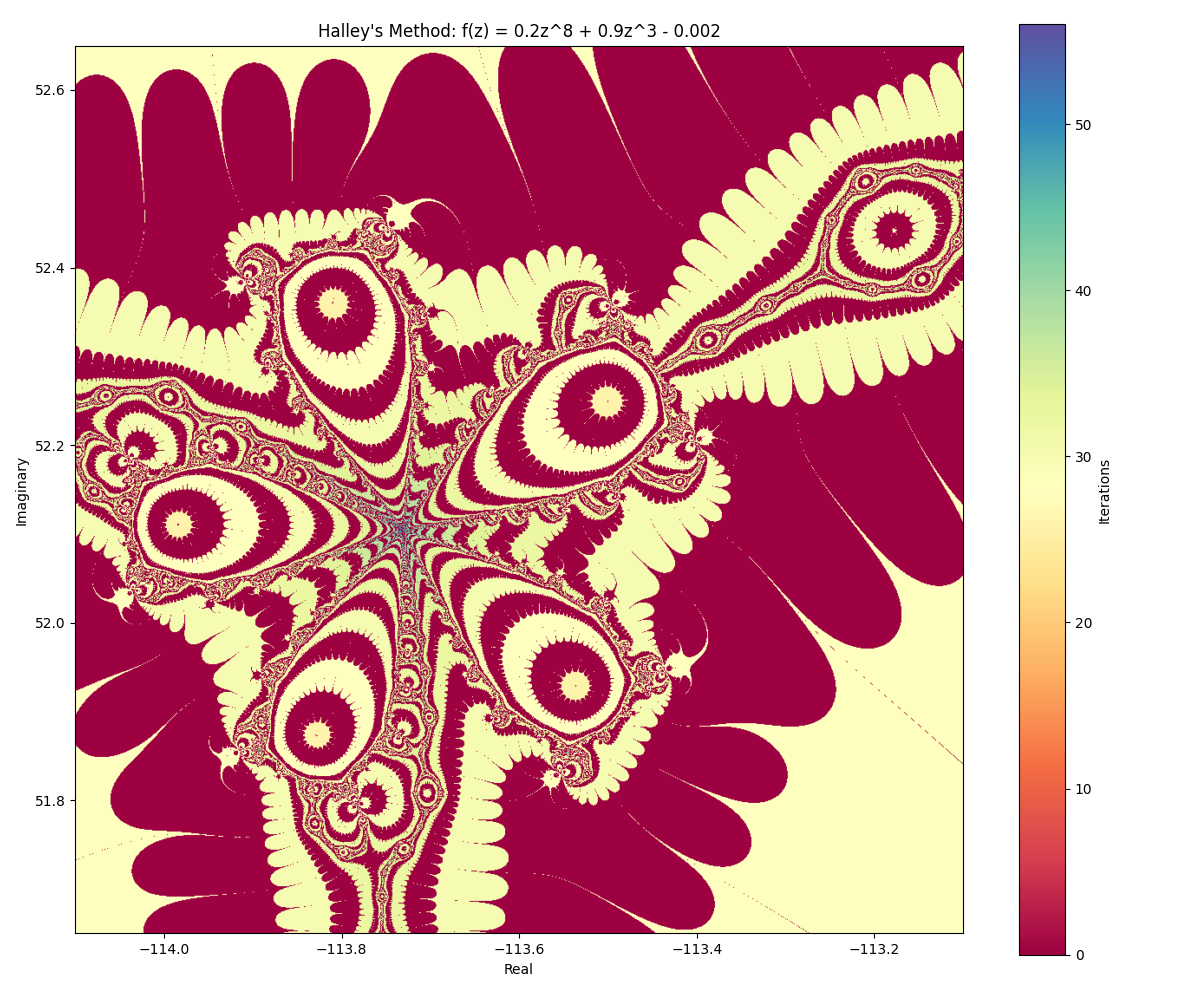
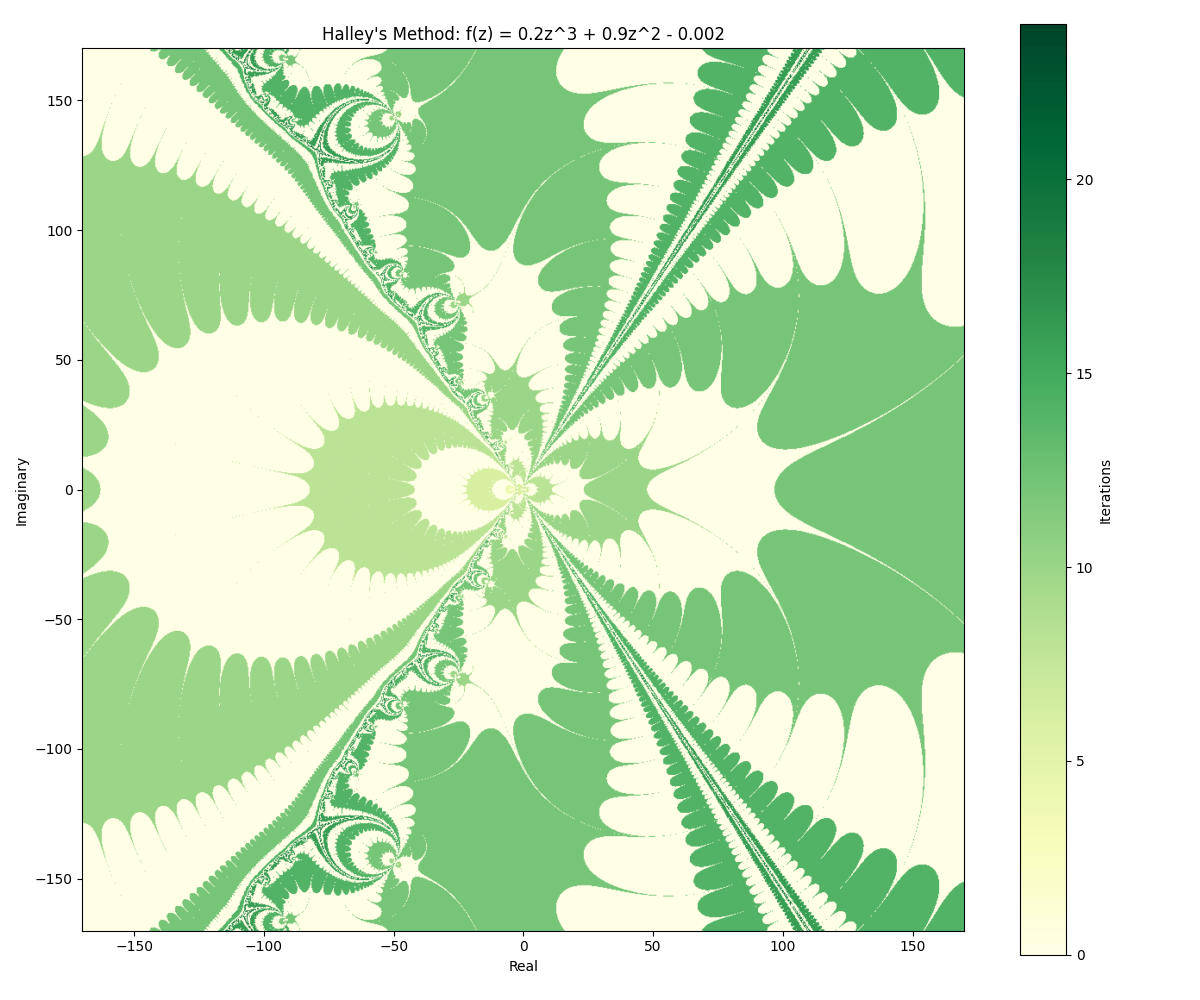
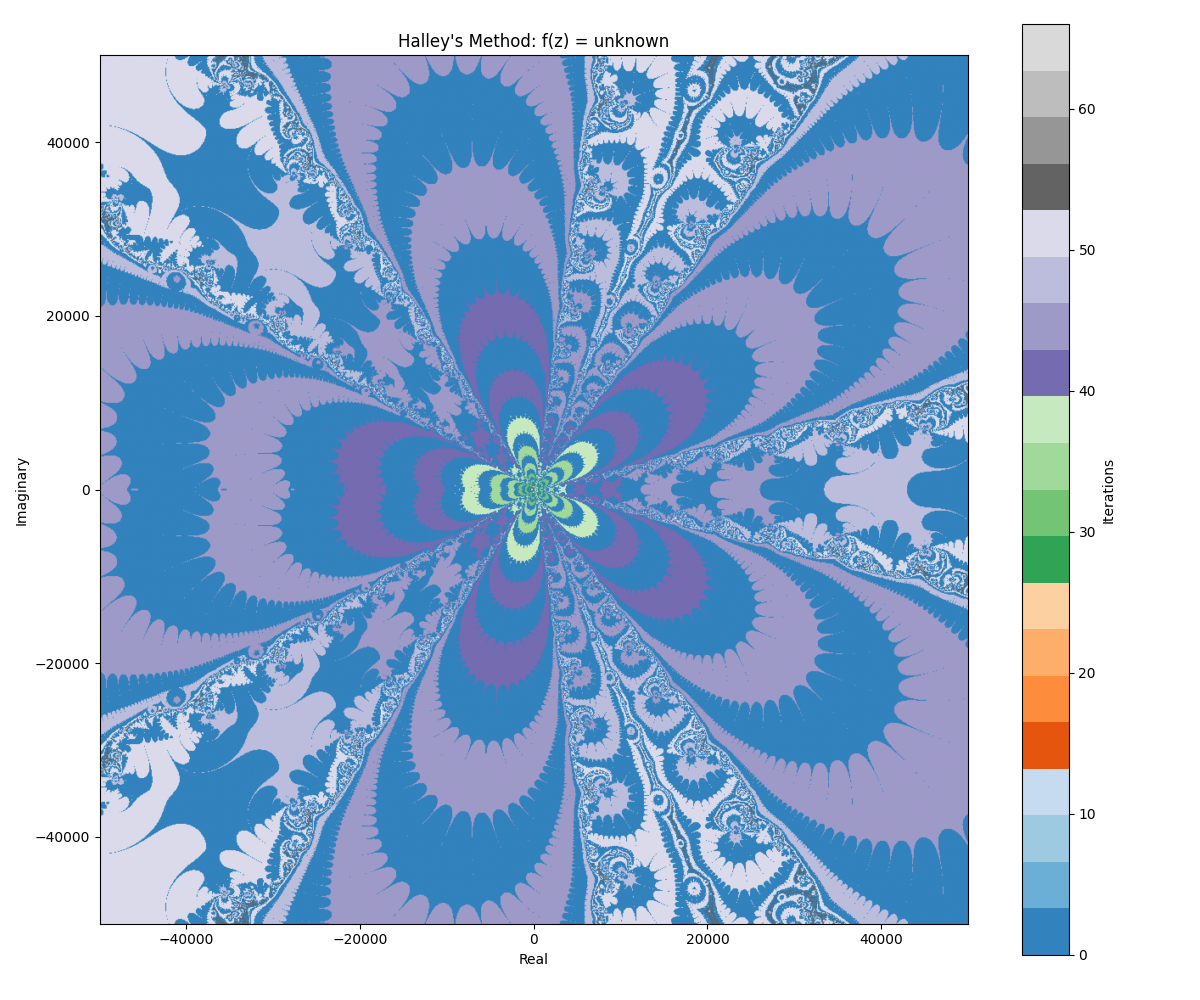
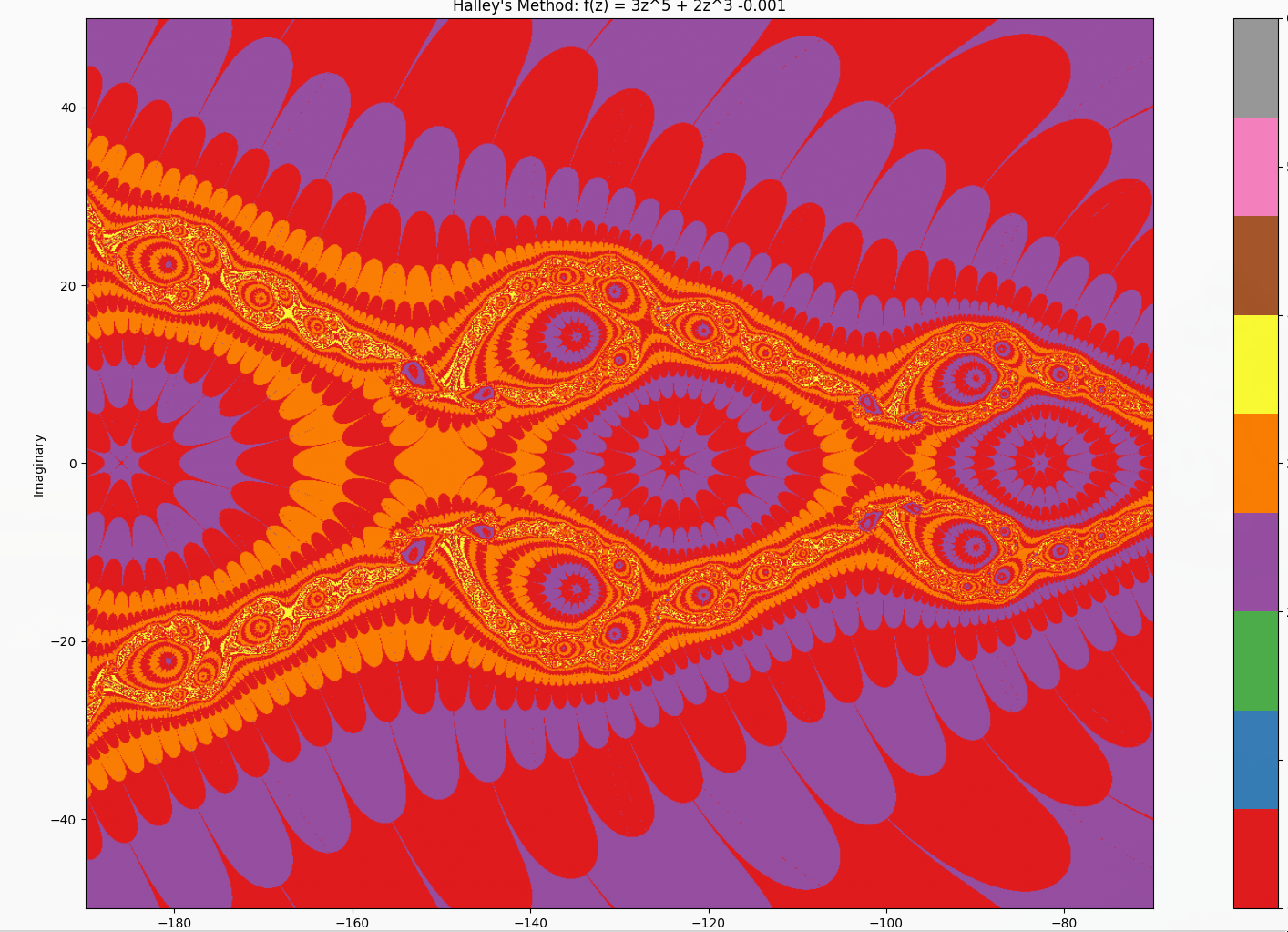
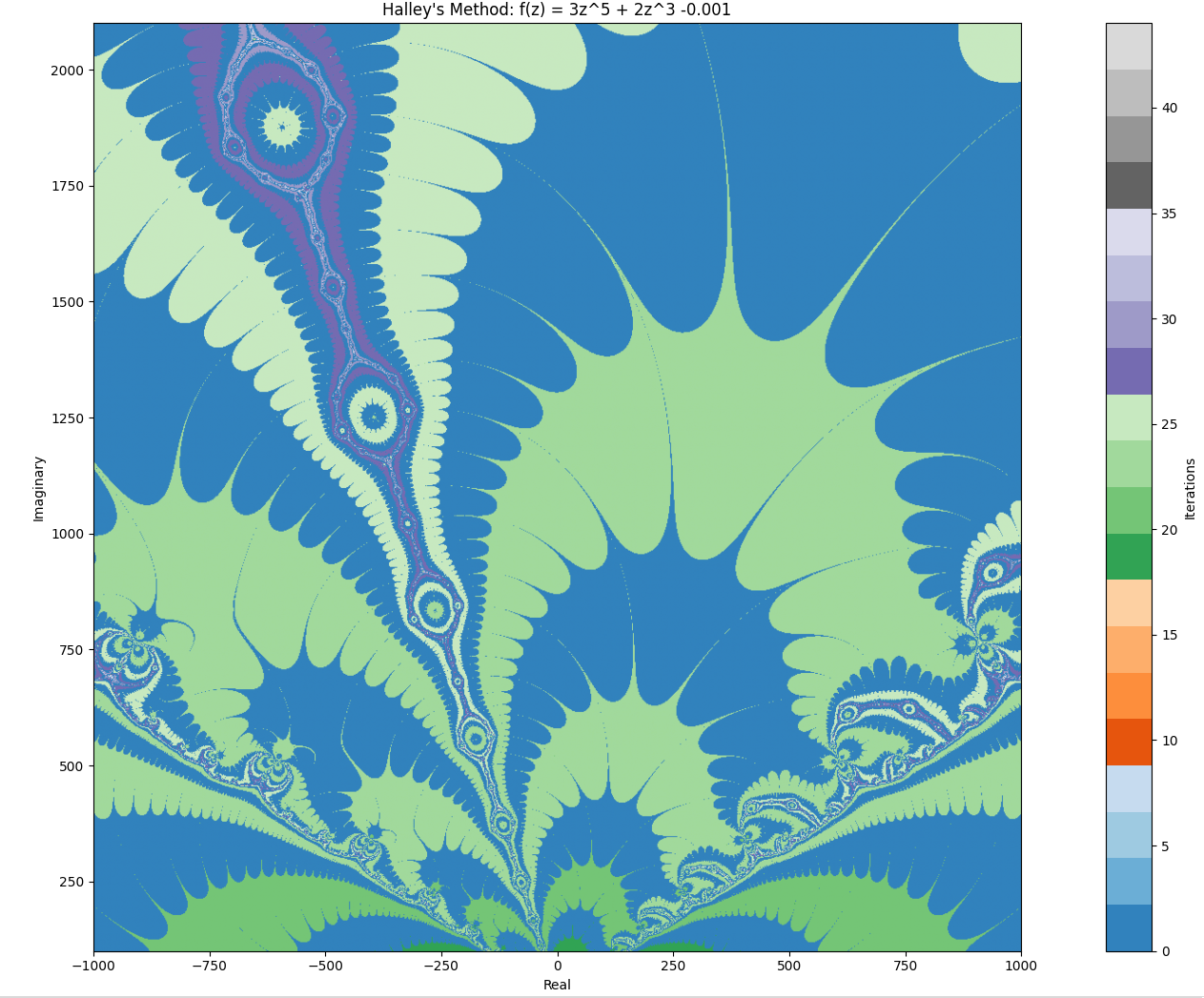
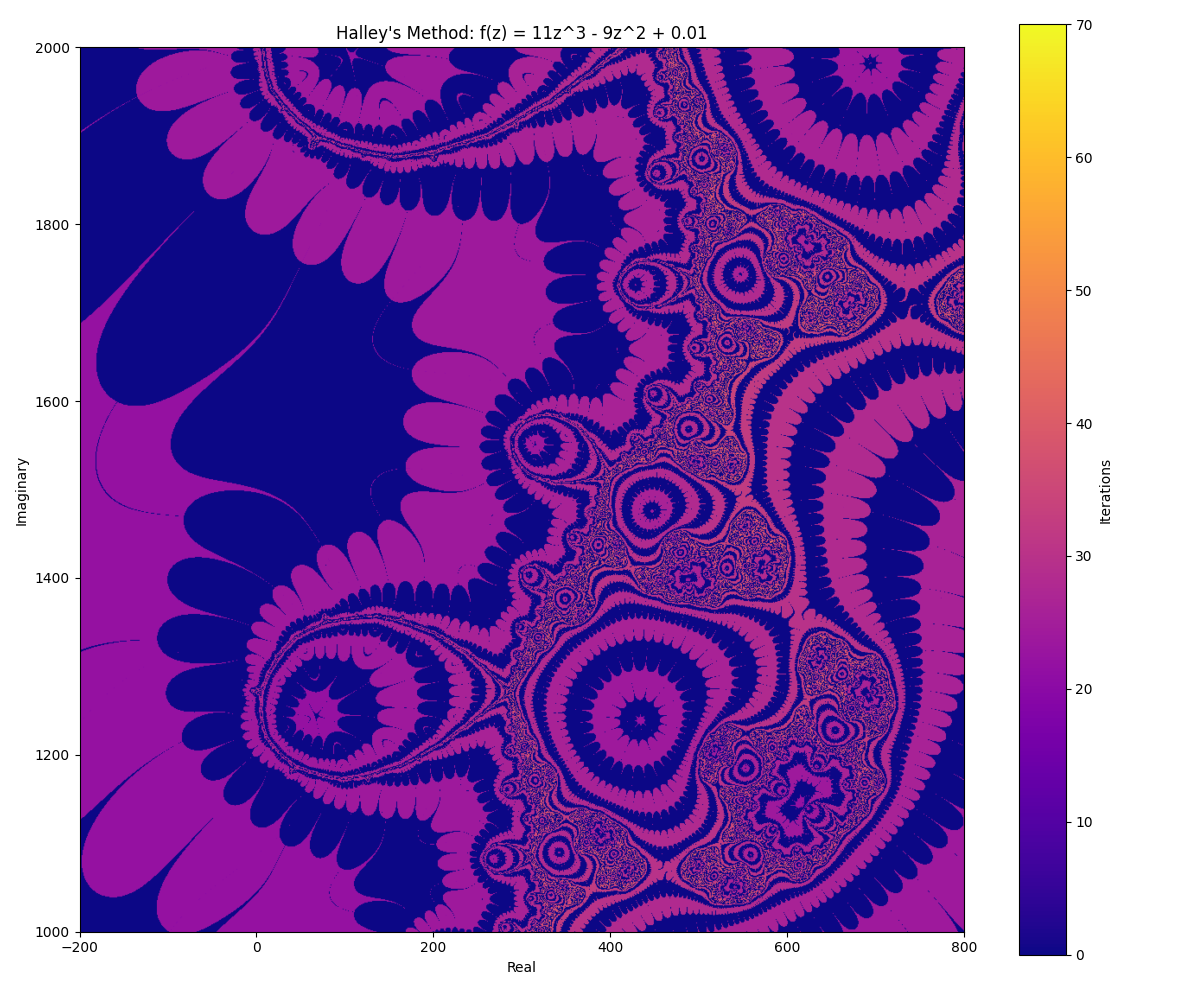
Code #
import numpy as np
import matplotlib.pyplot as plt


def halley_fractal(
    f,
    df,
    ddf,
    roots,
    width=800,
    height=800,
    xmin=-2,
    xmax=2,
    ymin=-2,
    ymax=2,
    max_iter=50,
):
    """
    Generate a fractal using Halley's method.

    Returns:
    image array
    """

    # create a grid of complex numbers
    x = np.linspace(xmin, xmax, width)
    y = np.linspace(ymin, ymax, height)
    X, Y = np.meshgrid(x, y)
    Z = X + 1j * Y  # treat each coordinate as a complex number

    # arrays to store results
    root_map = np.zeros((height, width), dtype=int)
    iter_map = np.zeros((height, width), dtype=int)

    # apply halleys method to each point
    for i in range(height):
        for j in range(width):
            z = Z[i, j]

            for iteration in range(max_iter):
                fz = f(z)
                dfz = df(z)
                ddfz = ddf(z)

                # check for convergence
                if abs(fz) < 1e-6:
                    # determine which root z has converged to
                    distances = [abs(z - root) for root in roots]
                    root_idx = np.argmin(distances)
                    root_map[i, j] = root_idx
                    iter_map[i, j] = iteration
                    break

                # Halley's formula
                denominator = 2 * dfz**2 - fz * ddfz
                if abs(denominator) < 1e-15:
                    break
                z = z - (2 * fz * dfz) / denominator

            else:
                # didn't converge
                root_map[i, j] = -1
                iter_map[i, j] = max_iter
    return root_map, iter_map


# f(z) = z^3 - 1
# def f(z):
#     return z**3 - 1


# def df(z):
#     return 3 * z**2


# def ddf(z):
#     return 6 * z

# the three cube roots of 1
roots = [1, np.exp(2j * np.pi / 3), np.exp(4j * np.pi / 3)]
# roots [1, np.complex128(-0.4999999999999998+0.8660254037844387j), np.complex128(-0.5000000000000004-0.8660254037844384j)]

# max_iter = 100
# root_map, iter_map = halley_fractal(f, df, ddf, roots, max_iter=max_iter)
#
# # visualize
# fig, (ax1, ax2) = plt.subplots(1, 2, figsize=(14, 6))
#
# # show which root each point converges to
# im1 = ax1.imshow(root_map, extent=[-2, 2, -2, 2], cmap="tab10", origin="lower")
# ax1.set_title("Basins of Attraction")
# ax1.set_xlabel("Real")
# ax1.set_ylabel("Imaginary")
#
#
# # Show convergence speed (with color based on root)
# # Combine root and iteration info for more interesting coloring
# combined = root_map * max_iter + iter_map
# im2 = ax2.imshow(combined, extent=[-2, 2, -2, 2], cmap="hot", origin="lower")
# ax2.set_title("Convergence Speed")
# ax2.set_xlabel("Real")
# ax2.set_ylabel("Imaginary")
#
# plt.tight_layout()
# plt.show()

# Halley's fractal single root (Claude's attempt to convert Michael Levin's Matlab code to python)


def halley_convergence_fractal(
    f,
    df,
    ddf,
    width=1024,
    height=1024,
    xmin=-5.0,
    xmax=1.0,
    ymin=-7.0,
    ymax=-2.5,
    max_iter=50,
    # epsilon=1e-5,
    epsilon=1e-6,
):
    """
    Generate a Halley's method fractal based on convergence rate.
    """
    # Create grid of complex numbers
    x = np.linspace(xmin, xmax, width)
    y = np.linspace(ymin, ymax, height)
    X, Y = np.meshgrid(x, y)
    Z = X + 1j * Y

    # Arrays to store results
    iter_map = np.zeros((height, width), dtype=int)

    # Apply Halley's method to each point
    for i in range(height):
        for j in range(width):
            z = Z[i, j]
            # g_prev = abs(z) ** 2  # Note: this is weird, doesn't get used due to the (correct) K > 1 condition
            g_prev = None  # initializing to None; doesn't get used unitl K > 1

            for k in range(1, max_iter + 1):
                fz = f(z)
                dfz = df(z)
                ddfz = ddf(z)

                # Halley's formula
                denominator = 2 * dfz**2 - fz * ddfz
                if abs(denominator) < 1e-15:
                    break

                z = z - (2 * fz * dfz) / denominator

                # Check convergence
                g = abs(z) ** 2
                if k > 1 and abs(g - g_prev) < epsilon:
                    # Converged - store iteration count
                    if (
                        k % 2 == 0
                    ):  # this is in the original code and seems to produce more intersting patterns
                        iter_map[i, j] = k
                    break

                g_prev = g

    return iter_map, x, y


# Functions
# def f(z):
#     return z**2 + 0.001
#
#
# def df(z):
#     return 2 * z
#
#
# # z isnt' accessed, but it's convenient to keep in in the function signature
# def ddf(z):
#     return 2


# def f(z):
#     return z**9 - 1
#
#
# def df(z):
#     return 9 * z**8
#
#
# def ddf(z):
#     return 72 * z**7


# def f(z):
#     return z**8 + 3 * z - 0.01
#
#
# def df(z):
#     return 8 * z**7 + 3
#
#
# def ddf(z):
#     return 56 * z**6

# the general pattern
# f(x) = 3x^5 + 2x^3 - 1
# f'(x) = 15x^4 + 6x^2
# f''(x) = 60x^3 + 12x


def f(z):
    return 3 * z**5 - 3.7 * z**3 - 0.002


def df(z):
    return 15 * z**4 - 3.7 * 3 * z**2


def ddf(z):
    return 60 * z**3 - 3.7 * 3 * 2 * z


# Generate fractal with Levin's parameters
print("Generating fractal...")
result, xs, ys = halley_convergence_fractal(
    f,
    df,
    ddf,
    width=1024,
    height=1024,
    xmin=-1000,
    xmax=1000,
    ymin=100,
    ymax=2100,
    max_iter=300,
)

# Visualize
plt.figure(figsize=(12, 10))
plt.imshow(
    result,
    extent=(xs[0], xs[-1], ys[0], ys[-1]),
    # cmap="hot",
    cmap="tab20c",
    origin="lower",
    interpolation="bilinear",
)
plt.title("Halley's Method: f(z) = 3z^5 + 2z^3 -0.001")
plt.xlabel("Real")
plt.ylabel("Imaginary")
plt.colorbar(label="Iterations")
plt.tight_layout()
plt.show()

print(f"Iteration range: {result.min()} to {result.max()}")
print(f"Non-zero pixels: {np.count_nonzero(result)}/{result.size}")
References #
Levin, M. “Platonic space: where cognitive and morphological patterns come from (besides genetics and the environment)”. March 9, 2025. https://thoughtforms.life/platonic-space-where-cognitive-and-morphological-patterns-come-from-besides-genetics-and-environment/
Levin, M. “Halley’s Method fractal art”. October 3, 2023. https://thoughtforms.life/halleys-method-fractal-art/
Tags: