Notes on cognitive and morphological patterns
Notes taken while reading Dr. Michael Levin’s article: Platonic space: where cognitive and morphological patterns come from (besides genetics and environment) . Levin explains the basic logic behind what he’s written about in the preprint Ingressing Minds: Causal Patterns Beyond Genetics and Environment in Natural, Synthetic, and Hybrid Embodiments .
My interest in this comes from having looked at AI (deep learning, LLMs, etc.) from the point of view of a computer programmer. I’m unsatisfied with my explanation that AI is just a function running on a computer. I don’t find the functionalist (?) explanation of capabilities and possibly consciousness arising from complexity all that satisfying either.
Note that I tend to avoid copy/paste operations. Quotations from the article will be as accurate as I can make them. Also, this post is just me trying to get my head around something. Prefer Levin’s article over this one.
Physicalism is incomplete #
An empirical claim that I want to make strongly is this: we already know that physicalism is incomplete, because engineers and evolution exploit many “free lunches” — patterns that are useful and guide events in the physical world but are not themselves explained, set, or modifiable by the laws of physics. This includes things like facts about prime numbers, Feigenbaum’s constants , and many aspects of computation. Nothing you do in the physical world, even if you can modify all the constants at the start of the big bang, will change those truths.1
Physicalism #
Physicalism: “everything is physical”, the doctrine that the real world consists simply of the physical world. I’m not sure to what degree “physical” means “spacetime”.
Free lunches #
Attempts to understand useful patterns that are not set or modifiable by the laws of physics:
Prime numbers: a whole number greater than 1 that cannot be exactly divided by any number other than itself and 1 (e.g. 2, 3, 5, 7, 11). Nothing that you could do in the physical world would change the fact that 11 can only be divided by 11 and 1.
Euler’s number: see notes / Understanding Euler’s number.
The Pythagorean theorem (in Euclidean space(?)):
The sum of the interior angles of triangles: it’s not clear to me if interior angles of triangles summing to 180 degrees or the Pythagorean theorem are legitimate examples.
Platonism in the philosophy of mathematics #
“Mathematicians are already very comfortable with this — the old idea (Plato, Pythagoras, etc.) that there is a non-physical space of truths which we discover, not invent, and that this space has a structure that enables exploration.”2
Platonism about mathematics (or mathematical platonism) is the metaphysical view that there are abstract mathematical objects whose existence is independent of us and our language, thought, and practices…. Mathematical truths are therefore discovered, not invented.3
The Stanford article (quoted above) defines mathematical Platonism as:
- existence: there are mathematical objects
- abstractness: mathematical objects are abstract
- independence: mathematical objects are independent of intelligent agents and their language, thought and practices
It says that Platonism in general is any view that arises from the above three claims, replacing “mathematical” with any other adjective.
I’m not sure that “mathematical objects” is what Levin is getting at. Levin is talking about “mathematical truths,” things like Euler’s Number, not “mathematical objects” (numbers, sets, functions, etc.). The question isn’t “does 3 exist as a thing?”, it’s more like “does Euler’s formula hold true in any possible universe?” I think the idea is that the “free lunches” are necessary truths, they aren’t philosophical quibbles.
There’s a non-physical space of truths which we discover #
Levin suggests that the space contains more than things like Euler’s number and prime numbers (“low-agency forms”), it also contains “a very wide variety high-agency patterns that we call kinds of minds.”4
Physical bodies don’t create minds. Physical bodies are pointers to the minds (patterns) that exist in this space. Things that are built (“built” in this sense includes people, animals, AI’s) act as an interface to the patterns that exist in the other (“Platonic”) space. So in this view, AI, a parameterized program running on a computer isn’t creating a mind, or hypothetically creating consciousness, it’s an interface with something that already exists.
Dualism — the interaction between mind and matter #
Levin says this view is compatible with dualism (a mental world that interacts with the physical world). Idries Shah seems to have suggested that it’s physical all the way down, just successively refined states of matter.5 (TODO: find the quote.) I’m not sure that Shah is saying it’s spacetime all the way down though.
Levin’s goal is to attempt to understand these systems — the high-agency patterns that exist in this space. I’ll tentatively refer to the space as the space of “Platonic forms”, but I think that’s just being used as an analogy.
“Emergent” patterns form an ordered space #
The patterns shouldn’t be considered simply as facts that happen to hold true. Levin wants to start with the presumption that the patterns “form an ordered space, with a metric that enables systematic, rational investigation….”6
When we make systems (AI, etc.), we’re creating pointers into this space. The goal should be to understand the mapping between what we make (the pointers) and “the patterns of form and behaviour that appear”.7
An example of a “pattern of form” that’s given is Halley’s Method fractal art .
Abstract #
How best to explain the properties and capabilities of embodied minds? The conventional paradigm holds that living beings are to be understood as the sculpted products of genetics and the environment, which determine form and function of the brain as the unique seat of intelligence. Some provision is made for emergence and complexity, as additional “facts that hold” about networks, circuits, and other components of life.8
The article presents a framework that differs from this view in “key aspects”
-
“the evolutionary conservation of mechanisms and functionality indicate fundamental symmetries between the self-construction of bodies and minds”
-
“competencies” that exist in systems that have not been subject to natural selection suggest an additional input into patterns of body and mind.
Full quote related to above point:
…surprising competencies (not just complexity or unpredictability) in systems that have not had a history of selection for those abilities suggest an additional input into patterns of body and mind that motivates a research program on a latent space of patterns ingressing into the physical world.
The evolutionary conservation of mechanisms and functionality: certain biological features (physical structures, molecular mechanisms, functional processes(?)) are conserved because they are inherited from common ancestors.
Competencies is an interesting term here. Possibly look at Levin’s paper related to bubble sort: Algorithms Redux: finding unexpected properties in truly minimal systems .
What are the implications of the following?
-
evolution favors living forms that exploit truths of mathematics and computation as affordances. These “truths” contribute to morphological and behavioural changes.
-
“Cognitive patterns are an evolutionary pivot of the collective intelligence of cells.”9 This is intended to suggest a similarity between neuroscience (cognitive patterns) and developmental biology (morphological changes)(?). “…the relationship between mind and brain is the same as the relationship between mathematical patterns and the morphogenetic outcomes they guide.”10
-
many mathematicians suggest that these patterns (“truths of mathematics”(?)) are not “random facts”. (The patterns exist in latent space(?))
Related to the last point, the idea seems to be that the “truths of mathematics” — “low agency patterns”, e.g. prime numbers, exist in a kind of Platonic space. Levin hypothesizes that higher agency patterns that can be thought of as “kinds of minds” also exist in this space.
I’m not a biologist or a mathematician, so it’s a bit of a stretch to be reading/writing about this. Levin proposes/hypotheses that “we [should (?)] take seriously for developmental, synthetic, and behavioral biology the kinds of non-physicalist ideas that are already a staple of Platonist mathematics;”11
“what evolution (and bioengineering, and possibly AI) produces are pointers into that Platonic space…”12. This suggests that the distinction between life and machine is artificial.(?)
The idea is that the patterns that exist in this “Platonic space” “ingress” into (my grammar, seems a bit off) physical space. The idea seems to be that things that are built in the world create a kind of portal (again, my words and not quite right). My sense here is that language is going to tend to be a bit off if the terms from this world (spacetime(?)) are used to describe some other kind of space.
Levin’s idea (what he’s working on now(?)) is to map out the regions of this Platonic space — to understand the mapping between the physical and the patterns that it points to.
How patterns arise (physics and biology) #
Physicists accept the idea of patterns arising from mathematical causes such as symmetries 13
Claude (Sonnet 4.5) (loosely quoted, not super-helpful, as I’m starting in the middle and not putting in the required work):
When physicists talk about “patterns arising from mathematical causes”, they mean patterns that emerge not because of specific physical mechanisms, but because of deeper mathematical constraints or symmetries. E.g., energy conservation emerges from time-translation symmetry:
Imagine a pendulum swinging, now mentally shift the entire history of that system forward by one second. The pendulum behaves in exactly the same way, just one second later (?)
Energy conservation isn’t an additional law we discovered about nature. It’s the mathematical consequence of the fact that the laws of physics don’t change over time.
(I can’t go into this right now, have a look at Noether’s theorem .)
Biologists typically understand patterns (morphological and behavioral (?)) as arising from one of two sources:
- heredity
- environment
This implies the existence of a pool of possible solutions(?) — the solutions that are accepted and the solutions that aren’t selected.
Levin is interested in the source of order that pervades the living and non-living world (other than heredity and environment).
Mathematical sources of order #
Mathematical facts that don’t depend on facts from physics. The criteria for determining if something is “physical” or not should be whether or not it depends on physics.14
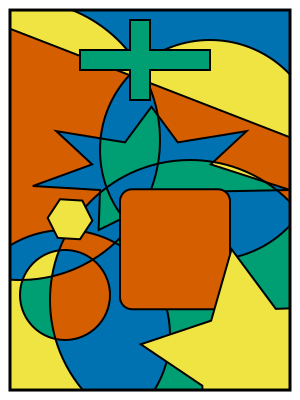
The four color theorem #
No more than four colors are required to color the regions f any map, so that no two adjacent regions have the same color.
Feingenbaum constants #
In systems like the logistic map (systems that undergo periodic doubling on the route to chaos), the period-doubling cascade following a specific mathematical pattern. Note that I need to confirm what kinds of systems this applies to. The pattern is:
- Period-1 → Period-2 (bifurcates at r₁ ≈ 3.0)
- Period-2 → Period-4 (bifurcates at r₂ ≈ 3.449)
- Period-4 → Period-8 (bifurcates at r₃ ≈ 3.544)
- Period-8 → Period-16 (bifurcates at r₄ ≈ 3.564)
Feigenbaum discovered that the spacing between consecutive bifurcation points shrinks by a constant ratio: .
This means:
Each bifurcation happens about 4.669 sooner than the previous one.
The cannonball problem #
The cannonball problem: given a square arrangement of cannonballs, for what size of squares can these cannonballs also be arranged into a square pyramid?15
The answer is 4900 cannonballs (a square of 70x70 cannonballs.)
Any number in the form ABABAB is divisible by 37 #
This is for base 10 numbers where A is not equal to zero:
ababab can be expressed as a*100000 + b*10000 + a*1000 + b * 100 + a*10 + b*1
Simplifies to:
a * (100000 + 1000 + 10) + b * (10000 + 100 + 1) =
a * (101010) + b * (10101) =
Factor out the common factor of 10101:
10101 * (10 * a + b)
Since 10101 / 37 = 273, any number in the ABABAB form divided by 37 equals:
273 * (10 * A + B)
E.g.:
In [3]: 575757 / 37
Out[3]: 15561.0

In [4]: 273 * (50 + 7)
Out[4]: 15561
Halley plot #
This turned into a bit of a time-sink. See Halley’s Method for details.

Levin suggests that “the function [is] serving as an index or a pointer into a morphospace of possible shapes.”16
Dynamic Platonic spaces #
The idea that the patterns in this space aren’t static comes up a few times. What’s meant by that?
Logical sentences are dynamic? #
“Obvious denizens of the Platonic space include logical statements.”17 The Liars Paradox (“This sentence is false,”) creates an oscillation/loop.
Also look at McGilchrist’s comment about this: “there is no paradox if we allow the truth value to change and consider the time-extended behavior; the paradox arises from our trying to freeze a fundamentally dynamic pattern down into an assumption that a proposition should have a static truth value…”18
Machines do things that are not in the algorithm #
Algorithms do what they’re explicitly programmed to do, but they also do other things that aren’t in the algorithm. So there’s some freedom here.
Could the patterns be the agents? #
Terms #
Morphogenesis #
Morphogenesis is, literally “the generation of form”. In biology, it’s the process that causes a cell, tissue or organism to develop its shape. Morphogenesis controls the spatial distribution of cells during the embryonic development of an organism.19
Latent space #
A latent space is a compressed, abstract representation of data where similar items are located closer together.
“A latent space, also known as a latent feature space or embedding space, is an embedding of a set of items within a manifold in which items resembling each other are positioned closer to one another. Position within the latent space can be viewed as being defined by a set of latent variables that emerge from the resemblances from the objects.”20
Manifold #
In mathematics, a manifold is a topological space that locally resembles Euclidean space near each point.21
Topological space #
In mathematics, a topological space is (roughly), a geometrical space in which closeness is defined but cannot necessarily be measured by a numeric distance. It’s a set whose elements are called points, along with an additional structure called a topology — a set of “neighborhoods” for each point that satisfies some axioms formalizing the concept of “closeness”.22
Symmetry #
Mirror-image symmetry is a kind of symmetry. In physics/math, symmetry means that something stays the same when you apply a transformation:
-
the laws of physics will still work if an experiment is applied in the future — time-translation symmetry.
-
a sphere looks the same when it’s rotated — rotational symmetry.
Symmetry!:
In [4]: arr
Out[4]:
array([[0., 0., 0., 0.],
       [0., 0., 0., 0.],
       [0., 0., 0., 0.],
       [0., 0., 0., 0.]])

In [5]: arr == arr.T
Out[5]:
array([[ True,  True,  True,  True],
       [ True,  True,  True,  True],
       [ True,  True,  True,  True],
       [ True,  True,  True,  True]])
Prime number #
A whole number greater than 1 that can only be divided by itself and 1: (e.g. 2, 3, 5, 7, 11)
Perfect number #
A perfect number is a positive integer that equals the sum of its proper positive divisors (all divisors except the number itself):
- 6: proper divisors (1, 2, 3), sum of divisors: 1 + 2 + 3 = 6
Bibliography #
Levin, M. “Platonic space: where cognitive and morphological patterns come from (besides genetics and the environment)”. March 9, 2025. https://thoughtforms.life/platonic-space-where-cognitive-and-morphological-patterns-come-from-besides-genetics-and-environment/
Levin, M. “Ingressing Minds: Causal Patterns Beyond Genetics and Environment in Natural, Synthetic, and Hybrid Embodiments”. PsyArXiv, February 7, 2025. doi:10.31234/osf.io/5g2xj_v3.
-
Michael Levin, “Platonic space: where cognitive and morphological patterns come from (besides genetics and the environment)”, Forms of life, forms of mind, March 9, 2025, https://thoughtforms.life/platonic-space-where-cognitive-and-morphological-patterns-come-from-besides-genetics-and-environment/ ↩︎
-
Michael Levin, “Platonic space: where cognitive and morphological patterns come from (besides genetics and the environment)” ↩︎
-
Platonism in the Philosophy of Mathematics, Stanford Encyclopedia of Philosophy, March 28, 2023, https://plato.stanford.edu/entries/platonism-mathematics/ . ↩︎
-
Michael Levin, “Platonic space: where cognitive and morphological patterns come from (besides genetics and the environment)” ↩︎
-
Idries Shah, “The Sufis”, TODO: find the reference. ↩︎
-
Michael Levin, “Platonic space: where cognitive and morphological patterns come from (besides genetics and the environment)” ↩︎
-
Michael Levin, “Platonic space: where cognitive and morphological patterns come from (besides genetics and the environment)” ↩︎
-
Michael Levin, “Platonic space: where cognitive and morphological patterns come from (besides genetics and the environment)” ↩︎
-
Michael Levin, “Platonic space: where cognitive and morphological patterns come from (besides genetics and the environment)” ↩︎
-
Michael Levin, “Platonic space: where cognitive and morphological patterns come from (besides genetics and the environment)” ↩︎
-
Michael Levin, “Platonic space: where cognitive and morphological patterns come from (besides genetics and the environment)” ↩︎
-
Michael Levin, “Platonic space: where cognitive and morphological patterns come from (besides genetics and the environment)” ↩︎
-
Michael Levin, “Platonic space: where cognitive and morphological patterns come from (besides genetics and the environment)” ↩︎
-
Michael Levin, “Platonic space: where cognitive and morphological patterns come from (besides genetics and the environment)” ↩︎
-
Wikipedia contributors, “Cannonball problem,” Wikipedia, The Free Encyclopedia, https://en.wikipedia.org/w/index.php?title=Cannonball_problem&oldid=1289561886 (accessed December 8, 2025). ↩︎
-
Michael Levin, “Platonic space: where cognitive and morphological patterns come from (besides genetics and the environment)” ↩︎
-
Michael Levin, “Platonic space: where cognitive and morphological patterns come from (besides genetics and the environment)” ↩︎
-
Michael Levin, “Platonic space: where cognitive and morphological patterns come from (besides genetics and the environment), (From Iain McGilchrists response)” ↩︎
-
“Morphogenesis”, Wikipedia, September 30, 2025, https://en.wikipedia.org/wiki/Morphogenesis . ↩︎
-
“Latent Space”, Wikipedia, November 17, 2025, https://en.wikipedia.org/wiki/Latent_space . ↩︎
-
“Manifold”, Wikipedia, November 17, 2025, https://en.wikipedia.org/wiki/Manifold . ↩︎
-
Wikipedia contributors, “Topological space,” Wikipedia, The Free Encyclopedia, https://en.wikipedia.org/w/index.php?title=Topological_space&oldid=1312260885 (accessed December 7, 2025). ↩︎